


Today, I went on a hike and then took a dip in the sea. It was windy and cold but exactly what my body needed, a reset of sorts. I had a somewhat difficult month, and it’s taking me some time to get out of the emotional slumber.
As usual, I turned to books, as other people’s stories always make me feel better. I’ve been reading Beyond Grief, and it’s such a beautiful compassionate book. The loss Pippa went through is unimaginable, much worse than what I experienced, but reading it helped me work through my own grief.
But I want to talk about something else. I started thinking about self-help books. I know a lot of people look down on them, but I find some of them to be great companions and motivators, so I decided to compile a list of books that helped me in life in all its areas: creativity, body, productivity, and more.
I use the term pretty liberally. Not all of these books are traditional self-help, but they helped me, or, I suppose, I helped myself after reading them, hence I consider them somewhat self-help.
I am not going to recommend Eckhart Tolle. I read somewhere that his wife picks up socks after him. Pick up your own socks, Eckhart.
So here we go.
Pleasure Activism: The Politics of Feeling Good by adrienne maree brown
It’s a wide-ranging book that treats pleasure as a serious force for liberation, not a side note to politics or self-care. It brings together essays, interviews, poetry, and art to explore desire, joy, embodiment, consent, and justice, asking what changes when we centre feeling good as a legitimate goal. I love both adrienne’s writing and her ideas.
Our radical imagination is a tool for decolonization, for reclaiming our right to shape our lived reality.
- adrienne maree brown
The Desire Map: A Guide to Creating Goals with Soul by Danielle Laporte
This book is about goal settings but it starts with feelings, not achievements. I reread (or actually mostly re-listen, the audiobook is great - her voice is very soothing) parts of it before every New Year. Danielle LaPorte’s central idea is that you should identify how you want to feel in your life, then shape your goals around those core desired feelings rather than chasing external markers of success. I started my Substack after reading this book.
I want to feel good more than I want to check accomplishments off my list.
- Danielle Laporte
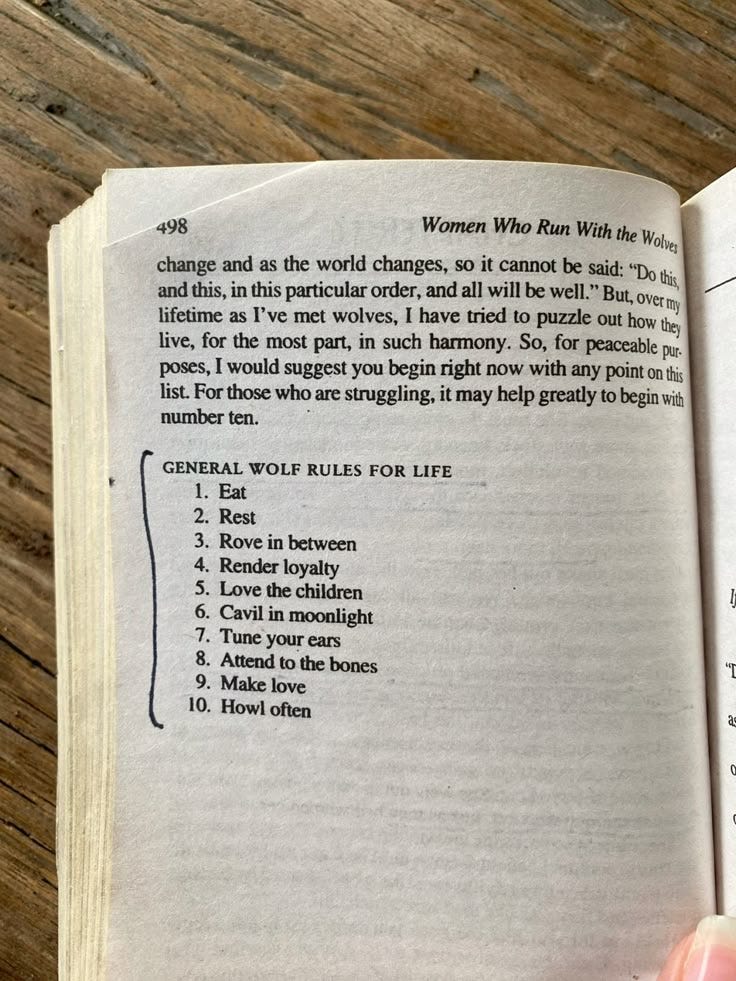
Women Who Run with the Wolves by Clarissa Pinkola Estés
Some people would probably punch me in the face for calling this work self-help. And, perhaps, rightfully so. It is so much more than that. But, again, it’s helpful!
It is a mythic, psychological, and symbolic book about reclaiming instinct, creativity, and the “Wild Woman” archetype. Estés uses folklore and fairy tales to explore how women lose touch with their inner life through social pressure, trauma, and self-suppression. It’s a great tool to help you recover a stronger sense of inner authority.
I saw someone on Goodreads quote Tennessee Williams to describe it. They called it “a loud, shameless ‘prayer for the wild at heart still kept in cages.’” I quite like that.
It is not an easy read. I actually think it is hundred pages too long. Nevertheless, it’s an excellent book.
There is a lot of criticism. Some of it, I am sure, is valid, but I personally benefited a lot from it, and I hope you do too. Make love. Howl often.
Big Magic by Elizabeth Gilbert
Gilbert is a brilliant writer. She managed, once again, to create a lively, encouraging book about creative living without fear. Its message is that creativity does not belong only to “artists,” and that curiosity, permission, and play are often more important than perfection or genius. It is a great read if you want to write, make art, or simply live with more courage and less self-judgment.
Do whatever brings you to life, then. Follow your own fascinations, obsessions, and compulsions. Trust them. Create whatever causes a revolution in your heart.
- Elizabeth Gilbert
Design Your Day: Be More Productive, Set Better Goals, and Live Life On Purpose by Claire Diaz-Ortiz
Productivity books can be tricky, but this one is great. For once, it’s very short, you could probably finish it in one sitting.
It is a practical book about using your time more intentionally instead of letting the day disappear into reaction mode. It focuses on simple planning habits, clearer goals, and building a daily structure that supports both productivity and a more purposeful life. The book is a good fit if you want something straightforward and actionable rather than abstract motivation.
I implement a lot of Diaz-Ortiz’ ideas in my daily life. I love her concept of the word of the year. It’s such a simple idea but, surpassingly, it works. It keeps me in touch with myself, my goals and desires.
None of her thoughts are groundbreaking, but they are concise and helpful.
Ultimately, the key to doing your best work in the least amount of time is to find those times that you do specific activities best, and do as much of those activities in that time period as possible.
- Claire Diaz-Ortiz
This book was recommended by Sara Blakely, and I love Sara Blakely.
It offers simple, grounded advice on staying focused, handling setbacks, breaking bad habits, and building a more steady sense of direction. It is somewhat philosophical but I don’t mind it. I quite like it, actually.
Again, it’s very short, and I must say, I appreciate it in books like that. It takes practice to organise your thoughts that well and to not repeat yourself over and over and over again.
Everyone can’t like everyone else. Even if people are prejudiced against you because of your race, age, gender, or religion, that’s their misfortune. As long as they don’t do anything directly to harm you, you will be better off making a conscious effort to restrain yourself from trying to challenge them or influence them to change their attitudes. Accusing others of ambivalent feelings or lack of interest in you may frustrate you, foster conflict, and provoke the very response that you anticipate. Avoid any inclination to respond to sarcasm or innuendo. Acknowledge that everyone has a right to think for himself and close the discussion.
- Ari Kiev
The Almanack of Naval Ravikant: A Guide to Wealth and Happiness by Eric Jorgenson
Naval is a finance bro, so that in theory should be enough for me to not recommend this book, but I genuinely believe him to be a good person. Or at least, his ideas about the world and what it means to be a good person are quite similar to my own.
The book was written from his tweets (he writes a lot of them apparently, but they are good tweets) and interviews.
I can’t really explain why but I find his story and his thoughts very motivating. It is a very clear-eyed, idea-driven book about building a richer life in both the financial and emotional sense. It argues that wealth is not just money, but freedom, that happiness is something you can train through habits, perspective, and self-awareness, and that compounding effect is the building force of all areas of life. I never really thought much about compounding effect when it came to anything other than money, but after reading it, I do, and always take it into consideration.
I’d love to know your favourite self-help books!
How to support my work:
Subscribe, if you haven’t already!
Like, share, and leave a comment—this means the world to me.